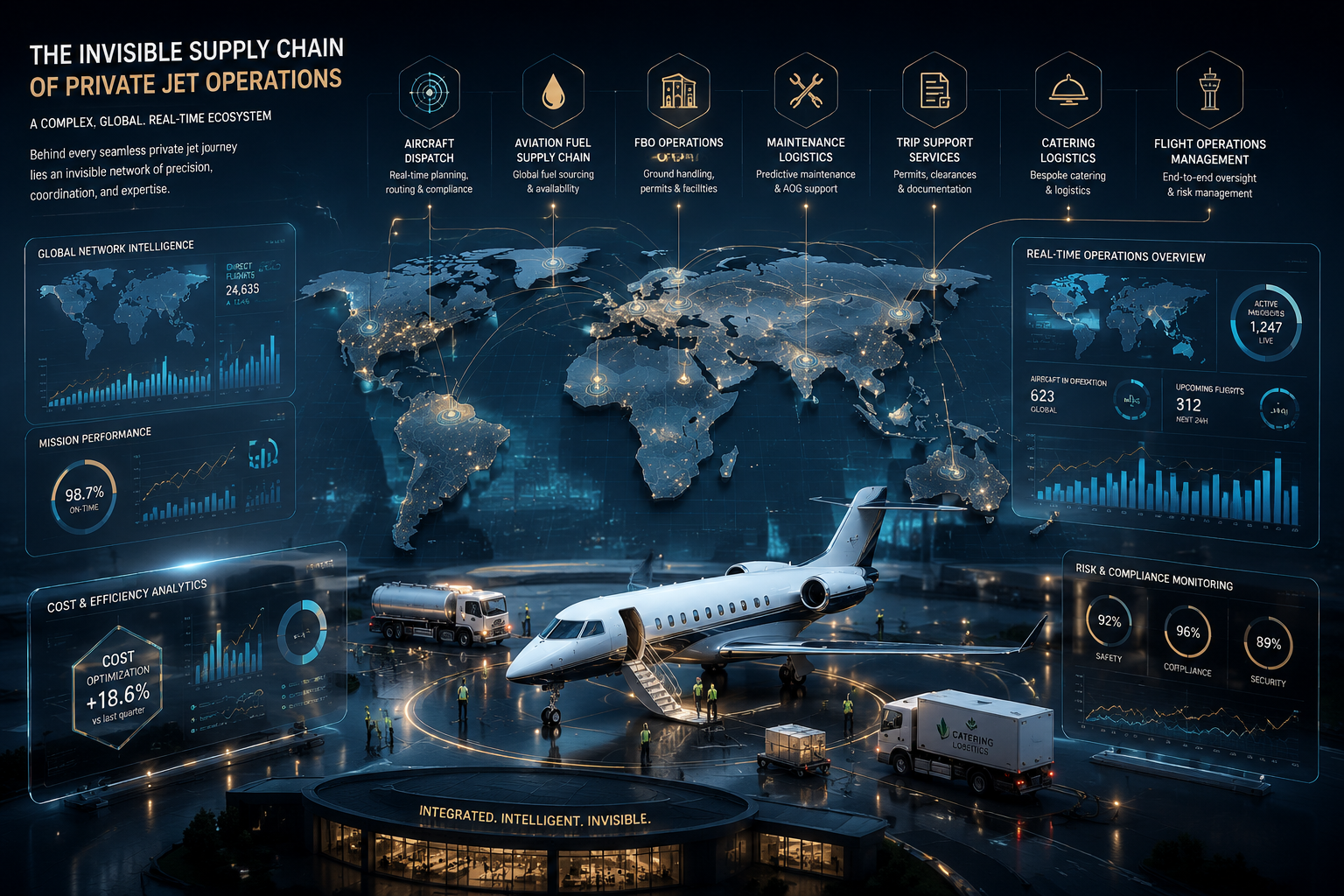
Private Jet Operations Supply Chain: The Invisible Aviation Network
Private aviation is often perceived as seamless luxury: a jet arrives, passengers board, and the aircraft departs within minutes. Yet behind this experience lies a highly complex and globally distributed private aviation supply chain that coordinates fuel, maintenance, staffing, routing, permissions, catering, and ground handling in real time. Understanding this invisible system reveals why private aviation is one of the most operationally sophisticated industries in the world.
The private aviation supply chain is not a single process but an interconnected ecosystem of specialized providers working in synchrony. From flight planning centers to fuel logistics at remote airports, every movement is pre-orchestrated. This article breaks down that hidden architecture and shows how ultra-high-net-worth travel is truly delivered.
Understanding the Invisible Private Aviation Supply Chain
At its core, the private aviation supply chain is a real-time orchestration system that connects aircraft owners, operators, service providers, and regulatory bodies. Unlike commercial aviation, which relies on fixed schedules and hubs, private aviation operates dynamically across thousands of airports worldwide.
Every flight triggers a chain reaction:
- Aircraft availability must be confirmed
- Crew must be scheduled and compliant
- Fuel must be allocated at destination
- Ground handling must be coordinated
- Catering must be sourced locally or pre-positioned
- Airspace permissions must be secured
This entire process is supported by aviation supply chain management systems that function 24/7 across multiple time zones.
The Core Pillars of Private Jet Operations
The private aviation supply chain is built on several critical operational pillars that ensure reliability and precision.
- Aircraft Dispatch Services and Flight Coordination
Aircraft dispatch services are the operational nerve center of private aviation. Dispatchers manage flight planning, weather analysis, airspace routing, and regulatory compliance.
They coordinate directly with pilots and control centers to ensure optimal routing and safety. Without dispatch coordination, even the most luxurious aircraft cannot depart.
- Private Jet Maintenance Logistics
Maintenance is one of the most capital-intensive components of the ecosystem. Private jet maintenance logistics ensures aircraft remain airworthy, compliant, and optimized for performance.
This includes:
- Scheduled inspections
- AOG (Aircraft on Ground) emergency response
- Component replacement
- Engine performance monitoring
Maintenance providers operate globally, often repositioning parts and technicians across continents within hours.
- Aviation Fuel Supply Chain
The aviation fuel supply chain is one of the most strategically critical components. Jet fuel availability varies dramatically between airports, especially in remote or politically constrained regions.
Fuel logistics involve:
- Contracted fuel vendors
- Price optimization strategies
- Real-time availability checks
- Emergency fuel repositioning
Even minor disruptions in fuel supply can cascade into flight delays or rerouting.
- FBO Operations (Fixed Base Operators)
FBO operations define the passenger and aircraft ground experience. These private terminals provide services such as:
- Passenger lounges
- Customs and immigration clearance
- Aircraft parking and hangarage
- Ground handling coordination
FBOs are essential nodes in the private aviation supply chain, acting as the physical interface between air and ground ecosystems.
- Trip Support Services
Trip support services handle the administrative backbone of international private aviation. They manage:
- Overflight permits
- Landing permissions
- Slot coordination
- Regulatory documentation
Without trip support, cross-border private aviation would be operationally impossible at scale.
- Aircraft Catering Logistics
Aircraft catering logistics is a precision-driven segment of the supply chain. Unlike commercial catering, private aviation requires bespoke, time-sensitive, and often highly specific culinary arrangements.
Challenges include:
- Last-minute menu changes
- International food sourcing compliance
- Temperature-controlled delivery
- Airport security restrictions
Luxury expectations elevate catering into a high-stakes logistical operation.
- Flight Operations Management
Flight operations management integrates all moving components into a unified execution framework. It ensures that dispatch, maintenance, crew, and ground services align perfectly.
This includes:
- Operational oversight centers
- Real-time tracking systems
- Incident management protocols
- Coordination between stakeholders
It is the central nervous system of the entire private aviation supply chain.
How the Private Aviation Supply Chain Actually Works
To understand the system in practice, consider the step-by-step lifecycle of a single international private jet mission:
- Client requests a mission
- Aircraft availability is checked
- Crew is assigned and duty-legal checked
- Route is optimized by dispatch
- Fuel is pre-arranged at destination
- Overflight and landing permissions are secured
- FBO services are confirmed
- Catering is prepared and loaded
- Aircraft is inspected and released
- Real-time monitoring continues during flight
Each step depends on synchronized execution across global partners.
This is where the private aviation supply chain demonstrates its true complexity: thousands of micro-decisions made within hours to support a single seamless passenger experience.
Why the Private Aviation Supply Chain Is Invisible
The invisibility of the system is intentional. High-end aviation is designed to eliminate friction for the passenger. What appears as simplicity is actually layered complexity hidden behind operational orchestration.
Several factors contribute to this invisibility:
- Distributed global infrastructure
- Proprietary operational systems
- Fragmented service providers
- Real-time decision-making layers
- Regulatory variability across countries
Most passengers never see the coordination required to execute their journey.
Cost Architecture Within the Supply Chain
The private aviation supply chain is also a financial system. Costs are distributed across multiple operational nodes rather than centralized.
Key cost centers include:
- Fuel procurement volatility
- Maintenance scheduling inefficiencies
- Crew positioning and accommodation
- Airport handling fees
- Regulatory compliance costs
Each of these fluctuates based on geography, seasonality, and demand pressure.
The Strategic Importance of Aviation Supply Chain Management
Modern aviation supply chain management is increasingly driven by digital transformation. Operators now rely on predictive systems, automation tools, and real-time analytics.
Technologies include:
- AI-based route optimization
- Predictive maintenance platforms
- Digital trip planning systems
- Integrated operator dashboards
This evolution reduces delays and improves operational efficiency across the global fleet ecosystem.
Risk and Reliability in Private Aviation
Risk management is embedded at every layer of the private aviation supply chain. Even minor disruptions, such as weather volatility or fuel shortages can cascade into operational failure.
Key risk areas include:
- Airspace restrictions
- Geopolitical disruptions
- Technical aircraft issues
- Crew availability shortages
- Airport congestion
Operators mitigate these risks through redundancy planning and multi-vendor ecosystems.
The Human Network Behind the System
Despite technological advancement, private aviation remains deeply human-driven. Dispatchers, engineers, coordinators, and ground staff form a 24/7 global workforce.
Their coordination ensures that private aviation maintains its promise: speed, safety, and exclusivity without compromise.
This human layer is what ultimately differentiates private aviation from automated logistics systems.
Why UHNW Clients Depend on Supply Chain Precision
Ultra-high-net-worth individuals depend on aviation reliability not for luxury alone but for strategic mobility. Time efficiency, confidentiality, and global access are directly tied to supply chain performance.
For these clients, delays are not inconveniences, they are operational risks affecting business, diplomacy, and investment decisions.
Conclusion: The Invisible Engine of Global Mobility
The private aviation supply chain is one of the most sophisticated operational ecosystems in modern transportation. It blends logistics, technology, human coordination, and regulatory intelligence into a seamless service layer.
What appears as a simple private flight is in reality the result of thousands of synchronized micro-processes operating across continents.
For clients, understanding this system transforms how they perceive private aviation from luxury transportation to strategic infrastructure.
For operators, mastery of this invisible architecture defines competitive advantage.
References
- FAA Aviation System Overview
FAA Official Site - IATA Air Transport Operations Insights
IATA Operations - NBAA Business Aviation Resources
NBAA Insights
FAQ
What is the private aviation supply chain?
It is the coordinated global network of services, including dispatch, fuel, maintenance, and ground handling, that enables private jet operations to function seamlessly.
Why is the private aviation supply chain important?
Because it ensures safety, efficiency, and reliability in private aviation by synchronizing multiple independent operational systems in real time.
Who manages private jet operations behind the scenes?
Specialized teams including dispatchers, flight operations managers, trip support providers, and maintenance coordinators manage the entire ecosystem.
What causes delays in private jet operations?
Delays typically come from weather conditions, fuel availability issues, airspace restrictions, or maintenance requirements.
How is technology improving the aviation supply chain?
Through AI-driven routing, predictive maintenance, and integrated operational platforms that improve speed, accuracy, and reliability.