PrivateJetia Private Jet Fly 109
The private jet industry has undergone a remarkable transformation over the decades, with aircraft manufacturers playing a pivotal role in driving innovation, luxury, and performance. From the early days of private aviation to the cutting-edge jets of today, aircraft manufacturers have continuously pushed the boundaries of technology, design, and passenger comfort. The evolution of these manufacturers reflects broader trends in the aviation sector, including advancements in materials, engineering, and customer expectations.
In this article, we will explore the evolution of aircraft manufacturers in the private jet sector, tracing their journey from the early pioneers to the leading players of today. We will also examine the key factors that have shaped the industry, including technological advancements, regulatory changes, and the increasing demand for luxury and performance.
1. The Birth of Private Aviation: Early Innovations
The concept of private aviation dates back to the early 20th century, but it wasn’t until after World War II that private jets began to take shape. The military aviation developments during the war led to advances in jet engine technology, which were quickly adopted by civilian aircraft manufacturers. In the 1950s and 1960s, private jet travel became increasingly accessible to the elite, marking the beginning of the private jet sector.
One of the earliest and most influential aircraft manufacturers in the private jet sector was Learjet, founded by American aviation pioneer Bill Lear. Learjet’s first aircraft, the Learjet 23, made its debut in 1963. This revolutionary jet was one of the first to offer supersonic speeds, modern avionics, and a luxury cabin experience. The Learjet 23 and its successors, such as the Learjet 24 and Learjet 25, helped to establish the private jet as a symbol of wealth and exclusivity. Learjet’s success in the 1960s and 1970s paved the way for other aircraft manufacturers to enter the private jet market.
At the same time, Cessna Aircraft, traditionally known for its smaller general aviation planes, made its first significant leap into the private jet market with the introduction of the Cessna Citation I in 1972. The Citation I was an important milestone in the evolution of private jet travel, offering greater affordability and performance compared to the Learjet. Cessna’s Citation series would go on to become one of the most successful and widely recognized lines of private jets in the world.
2. The Rise of Luxury: Expanding Options in the 1980s and 1990s
As the 1980s and 1990s unfolded, the private jet industry began to evolve from a niche market for the ultra-wealthy into a more mainstream luxury offering. Aircraft manufacturers began to recognize the growing demand for larger, more comfortable jets with longer ranges. This period saw the rise of several key manufacturers that would go on to define the modern private jet sector.
One of the major players to emerge during this time was Gulfstream Aerospace, which introduced the Gulfstream GII in the early 1970s. Gulfstream’s G-series jets, particularly the GIV and G-V, revolutionized the private jet sector by combining long-range capabilities, luxury, and cutting-edge technology. Gulfstream’s focus on performance, comfort, and customization helped solidify its place as one of the premier manufacturers in the private jet industry. The company set a new standard for luxury private jets, with spacious cabins, advanced avionics, and state-of-the-art engines.
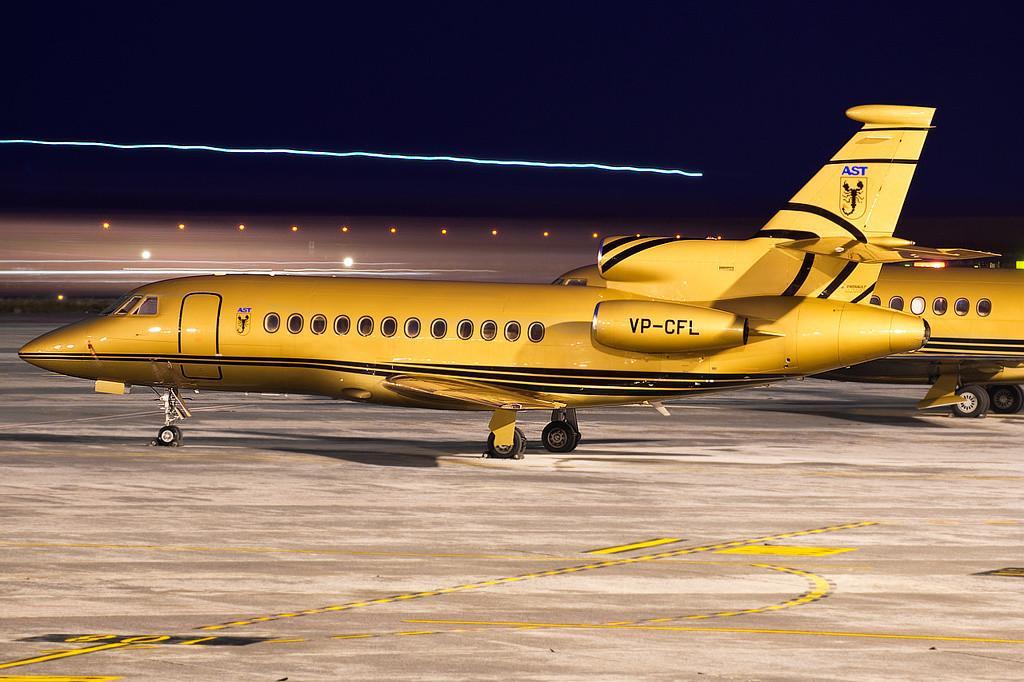
During the same period, Dassault Aviation, a French aerospace manufacturer, also began to gain prominence in the private jet market with its Falcon series. The Falcon 50, introduced in the late 1980s, was one of the first private jets to feature a fully integrated glass cockpit, offering greater precision and ease of operation. The Falcon 900, introduced in the early 1990s, became known for its long range and luxurious cabin. Dassault’s commitment to innovation and performance made it a key player in the luxury private jet market.
Another important manufacturer during this period was Bombardier Aerospace, which made significant strides in the private jet market with the introduction of the Challenger 600 series in 1980. The Challenger 600 was one of the first business jets to offer a wide-body cabin, providing ample space and comfort for passengers. Bombardier’s development of the Global Express in the late 1990s marked a major breakthrough in long-range private aviation, with the jet capable of flying over 6,000 nautical miles, making it ideal for intercontinental travel.
3. Technological Advancements and Global Reach: The 2000s and Beyond
The turn of the millennium saw significant technological advancements in the private jet sector, with manufacturers focusing on improving efficiency, safety, and passenger experience. As demand for private jet travel grew, so did the competition among manufacturers to produce more capable, luxurious, and technologically advanced aircraft.
One of the most significant developments during this period was the advent of fly-by-wire technology, which was first introduced to civilian aviation by Dassault Aviation with the Falcon 7X in 2005. The Falcon 7X was the first business jet to feature a fully digital fly-by-wire control system, allowing for more precise handling, reduced pilot workload, and enhanced safety. The 7X also featured a spacious cabin and impressive range, further cementing Dassault’s reputation as an industry leader.
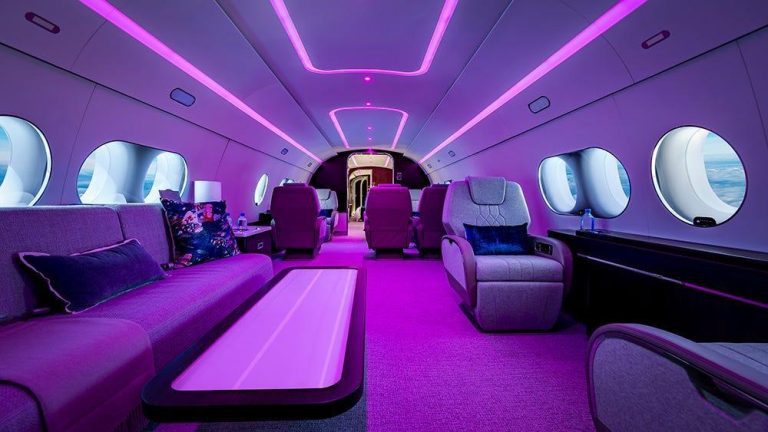
Meanwhile, Gulfstream introduced the G650, one of the most advanced and luxurious private jets in the world. The G650 set new standards for performance, with a top speed of Mach 0.925 and a range of 7,000 nautical miles. The aircraft’s cabin was designed with advanced materials and offered a wide range of customization options, including large windows, advanced lighting systems, and the latest in entertainment technology. The G650 became a symbol of private jet luxury and performance, appealing to business executives, celebrities, and high-net-worth individuals around the globe.
Bombardier also played a key role in this period with the introduction of the Global 7500 in 2018. The Global 7500 became the longest-range business jet in the world, capable of flying non-stop for over 7,700 nautical miles. The jet’s ultra-spacious cabin offered four distinct living areas, including a private suite with a bed, making it the ultimate in luxury travel. Bombardier’s Global series also benefited from advancements in fuel efficiency, noise reduction, and cabin pressurization technology, offering a more comfortable and sustainable flying experience.
4. Sustainability and the Future of Private Aviation
As the world becomes more focused on sustainability and reducing carbon emissions, private jet manufacturers are increasingly incorporating environmentally friendly technologies into their designs. The private jet industry has long been criticized for its environmental impact, but manufacturers are working to develop more fuel-efficient jets, explore sustainable aviation fuels (SAF), and reduce the carbon footprint of private aviation.
Gulfstream has made significant strides in this area, with the introduction of its G500 and G600 series. These jets feature advanced engines that improve fuel efficiency and reduce emissions, helping to minimize the environmental impact of private flying. Gulfstream has also invested in sustainable aviation fuel (SAF) testing and production, working toward a future where private jets can operate on greener, more sustainable fuels.
Similarly, Bombardier has focused on improving the environmental performance of its jets, with models like the Global 5500 and Global 6500 featuring more efficient engines and advanced aerodynamics to reduce fuel consumption. The company has also partnered with various organizations to explore the use of SAF and promote sustainability within the aviation industry.
Dassault has also made strides in improving fuel efficiency and reducing emissions, particularly with its Falcon 6X and Falcon 8X models. These jets feature advanced technology that optimizes fuel consumption, helping to reduce the environmental impact of private aviation while maintaining the high performance and luxury that Dassault is known for.
The future of private jet manufacturing will likely see even more focus on sustainability, with advancements in electric propulsion, hybrid engines, and the continued development of SAF. As governments and industry leaders work together to address climate change, the private jet sector will likely become more environmentally conscious, while still delivering the luxury, performance, and safety that passengers expect.
5. Key Players in the Modern Private Jet Market
Today, the private jet market is dominated by a few key players, each of whom has carved out a niche in the industry through innovation, performance, and luxury. The top aircraft manufacturers in the private jet sector today include:
- Gulfstream Aerospace – Known for its cutting-edge technology, long-range capabilities, and luxurious cabins, Gulfstream remains a leader in the private jet industry with models like the G650ER, G500, and G600.
- Bombardier Aerospace – Bombardier’s Global series, including the Global 7500, continues to be a favorite among high-net-worth individuals and business leaders for its performance, luxury, and range.
- Dassault Aviation – The French manufacturer’s Falcon series, including the Falcon 7X, 8X, and 6X, offers superior performance, luxury, and state-of-the-art technology.
- Embraer – A newcomer to the private jet market, Embraer has quickly become a key player with its Praetor and Phenom series, offering a mix of luxury and affordability for business travelers.
- Cessna – Cessna’s Citation series remains one of the most popular and accessible lines of private jets, offering a range of models from light to super-midsize jets.